

You set the site up on a weekend. A template you liked, your logo, a few photos of the treatment room, your services and prices typed in. It looked good. You felt ahead of it.
That was the easy part, and it was the only part with a finish line.
Six months later a therapist who left in the spring is still smiling on the team page. The prices are last year’s. A plugin update you didn’t install left a banner in your dashboard you’ve learned to ignore. The site loads slowly on a phone, which is where almost everyone actually finds you. None of this happened because you stopped caring. It happened because nobody told you that a website isn’t a project. It’s a role.
A website is a job, not a thing you own
Here’s the reframe that saves clinic owners a lot of grief: building the site was never the work. Running it is. And “running it” quietly bundles together about seven different jobs, each of which is somebody’s full-time profession somewhere else.
When an agency or a web developer “manages a website,” this is the list they’re actually being paid to cover. When you run your own, you inherit all of it.
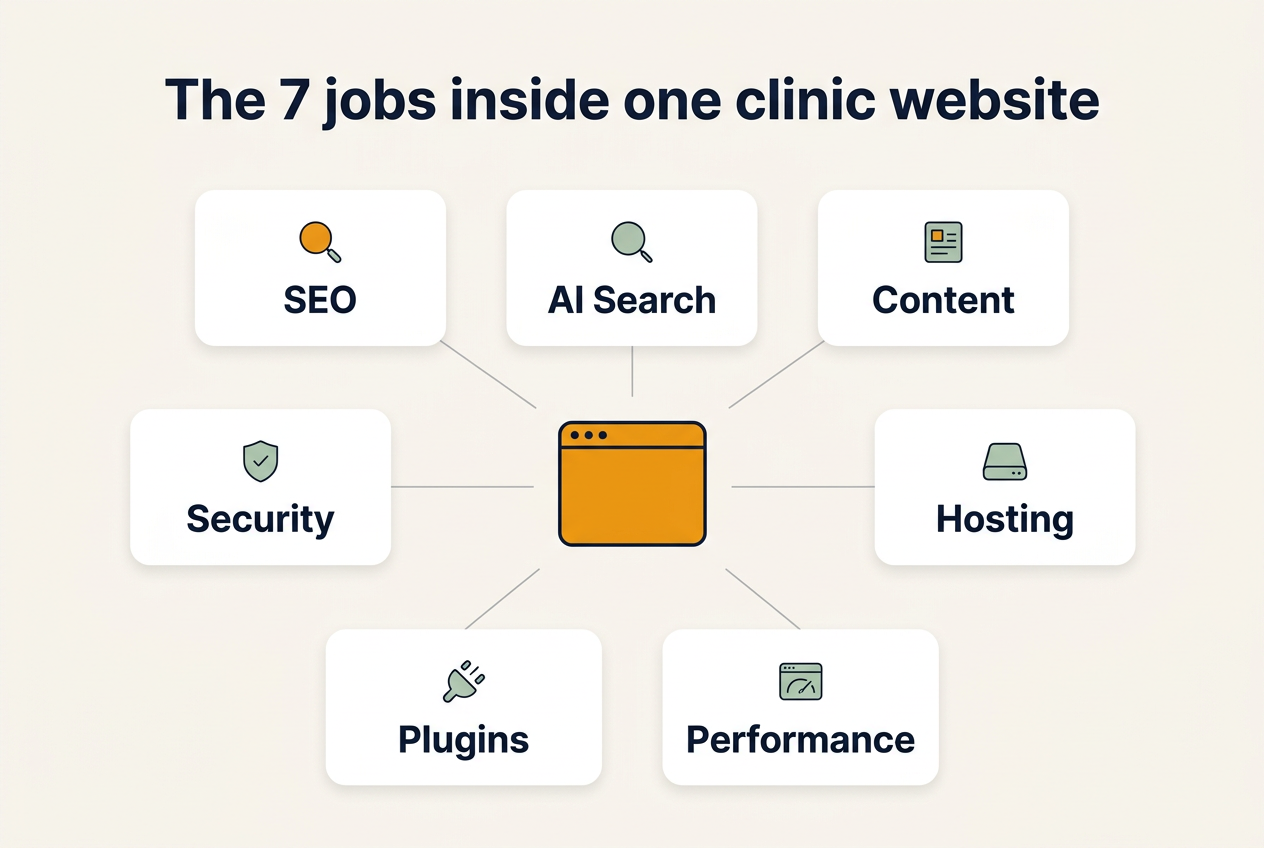
The seven jobs hiding inside “just make a website”
1. SEO, and it never stops moving. Showing up when someone searches “massage near me” is its own discipline, and the rules change constantly. Google rolled out four confirmed ranking updates in 2025, three core updates and a spam update, capped by a broad core update in December 2025, on top of thousands of smaller unannounced changes. Keeping up isn’t a one-time setup. It’s a subscription you pay in attention.
2. AI search, the new front door you don’t control. Search is shifting out from under everyone. A Pew Research Center study found that when Google shows an AI summary, people click a real result in just 8% of searches, about half the 15% rate when there’s no summary, and click a link inside the summary only 1% of the time. Getting your clinic mentioned by ChatGPT, Google’s AI Overviews, and the rest (sometimes called AEO, answer engine optimization) is now its own skill set, and it barely existed two years ago.
3. Writing and updating content. Pages don’t keep themselves accurate. Services change, prices change, hours change, staff change. Every one of those is a content edit somebody has to remember to make, and stale information is the fastest way to lose a client’s trust before they ever book.
4. Security patching. If your site runs on WordPress, which powers about 43% of the web. It’s a target. Roughly 90% of WordPress vulnerabilities come from plugins, the exact add-ons most small sites pile on to get booking, forms, and galleries working. Patches ship constantly, and the gap between “update available” and “update installed” is where sites get hacked.
5. Hosting. Someone has to keep the server up, renew the SSL certificate, manage backups, and be the one who panics when the site goes down on a Saturday morning. That’s a line item and a responsibility, not a set-and-forget.
6. Plugins and software upkeep. Every plugin and theme is software that ages. They need updating, they conflict with each other, and an update to one can quietly break another. The more your DIY site does, the more moving parts you’re personally on the hook to maintain.
7. Performance and technical health. Speed isn’t cosmetic. It’s revenue. Google found that 53% of mobile visits are abandoned if a page takes longer than three seconds to load, and the chance of a bounce climbs 32% as load time goes from one to three seconds. Keeping a site fast and technically clean is ongoing work, not a launch-day box to tick.
None of these are optional if you want the site to actually bring in bookings. They’re just invisible until something breaks.
The math nobody shows you
Put a number on it. A clinic owner running their own site honestly might spend two to four hours a month on edits, updates, and the occasional “why is this broken”, and that’s when nothing goes wrong. Hand it to a professional instead and you’re looking at maintenance retainers that commonly start around $200–$500 a month for a small site, with developers billing roughly $75–$200 an hour for anything beyond the plan.
So the DIY site that felt free costs you either a few hundred dollars a month or several hours of your own time, every month, forever.
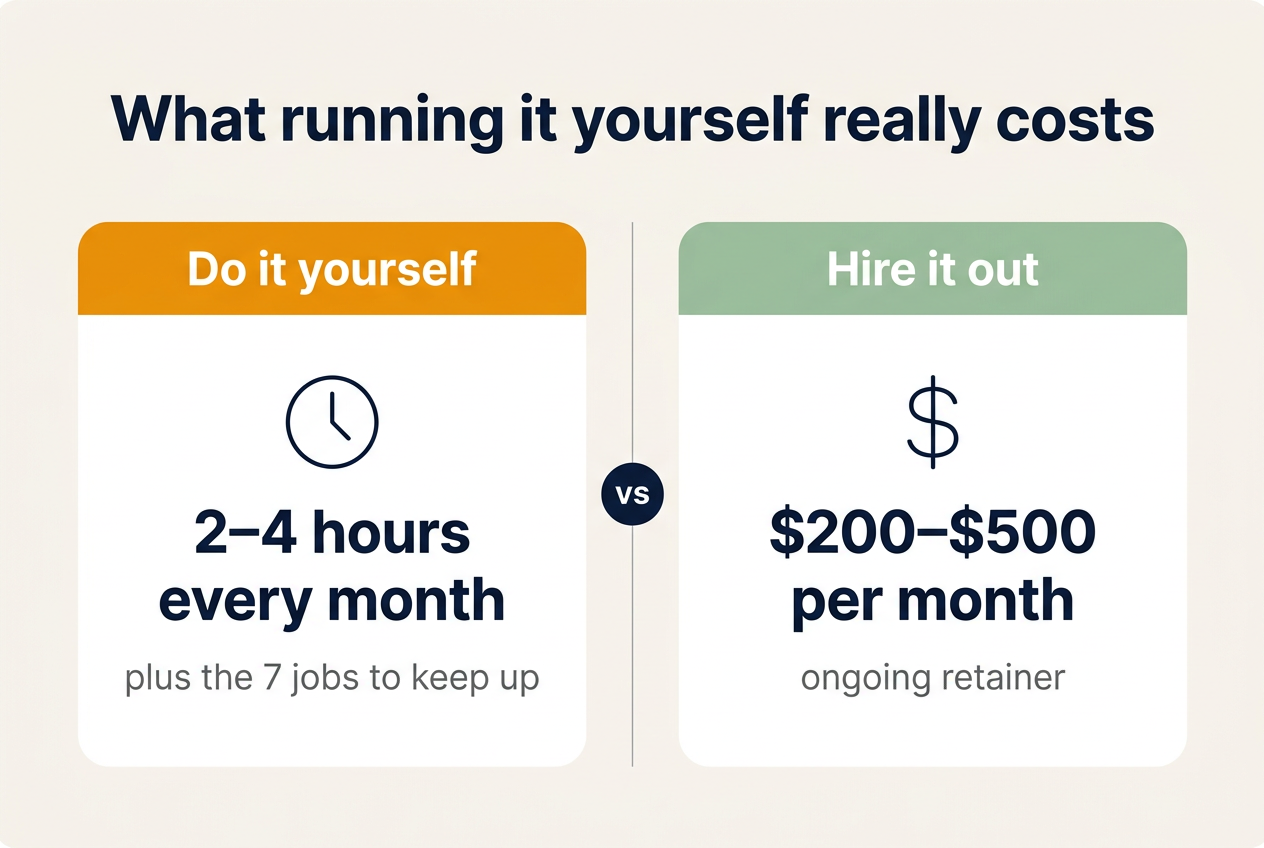
And the hidden third option, the one most clinics actually land on, is to pay nothing and do nothing, and let the site slowly drift out of sync with the clinic until it’s quietly working against you.
With Hivemanager.io, your clinic website is generated from the data you already manage, and the hosting, security, updates, and speed are handled for you. There's no separate site to maintain.
Why this hits massage clinics harder
For most small businesses, the website owner and the person doing the actual work are two different people. In a massage clinic, they’re usually the same person, and that person is also on the table treating clients.
Every hour you spend chasing a plugin conflict or rewriting a services page is an hour you’re not billing, not recovering, and not spending with the people you opened the clinic to help. The cost of running your own site isn’t really the retainer or the hosting fee. It’s the treatment hours and the headspace it pulls away from the part of the job only you can do.
This is the same trap behind most clinic websites going stale: not neglect, but the simple reality that keeping a separate site current is a second job layered on top of a first one. (It’s also why a good-looking site so often fails to convert, the design was never the problem.)
The fix isn’t doing it better. It’s removing the job
You can get better at all seven of these jobs. You can read SEO blogs, set update reminders, learn enough about hosting to be dangerous. Plenty of owners do, and it works right up until the clinic gets busy and the website slides back to the bottom of the list, where it belongs.
The more useful move is to stop treating the website as a separate thing you operate. When the site is generated from the same system you already run the clinic in, the seven jobs mostly disappear: you change a therapist, a price, or your hours once, and the site reflects it, while the hosting, security, patching, and speed are simply handled underneath. That’s the idea behind Hive Sites, and it’s a different bet than buying a builder and a stack of plugins.
A website should be the thing that fills your schedule, not another thing on your to-do list competing with it. If yours has quietly become the second, the answer isn’t more discipline. It’s giving the job back to a system built to do it, so the time goes back where it belongs, which was never the website to begin with. (And if you’re growing on a tight budget, there’s a lot you can do without spending big once the site itself stops eating your week.)
Sources
- Google’s AI Overviews are reducing click-throughs. Pew Research Center, 2025
- Google’s 2025 ranking algorithm updates in review. Search Engine Land
- WordPress content management market share. W3Techs
- State of WordPress Security: plugins as the main vulnerability source. Patchstack
- The need for mobile speed (53% abandon after 3 seconds). Google
- Website maintenance pricing benchmarks. WebFX